
The Second Ukrainian Innovation: Civic Resilience Between the Finnish Model and Europe’s Demand for It
In my previous column, I wrote about social innovations in Ukraine. Those innovations are part of civic resilience and the democratization of security, which Europe is paying close attention to right now. The EU is trying to work out how to spread responsibility for its own security across society as a whole, rather than leaving it to institutions alone. It is looking for concrete ways to bring ordinary people into the work of defense and resistance.
This question has become urgent because a new kind of war and aggression has moved beyond military institutions, and institutions of every kind. Today it targets the civic fabric of society itself. Sometimes that happens through direct aggression, as in Ukraine; sometimes through indirect aggression (disinformation, polarization, apathy) as in Europe.
In this column I want to show how Ukraine’s innovations in civic resilience fit into Europe’s wider thinking about the democratization of security. It helps to understand where Ukraine is heading as a European partner and player.
If you track the European security conferences of the past twelve years, you can see resilience and the democratization of security move to the center stage [18], [19], [20].
The EU started looking for new models of protection and response that might actually work. The one it keeps coming back to is Finland’s system known as Comprehensive Security.
What is the Finnish model, how does it work, and where does Ukraine come in?
The Finnish model comes from the idea that security is everyone’s responsibility, not the government’s alone, while most European countries still treat it as a service the state delivers.
There are three instruments that the Finns use.
The first is the National Defence Courses. They have run since 1961, and more than 10,000 of the country’s leaders have attended. They bring in officials, company directors, journalists, heads of civic organizations, and drop them into simulated crises. And the output is not knowledge, but relationships.
The second is public-private partnership. Critical infrastructure (telecoms, energy, ports) is protected not by the state on its own but by the state and business together, following protocols they have rehearsed in advance.
The third is regular joint exercises. Civilian and military bodies train side by side, working through crisis scenarios.
It’s a sophisticated system, and Europe has good reason to want it. Though it’s not easy to transfer it, and there are reasons for that.
First, the model grew out of very particular conditions: the memory of the Winter War of 1939–1940, a long border with Russia, a harsh climate, geographic isolation, and a small, equal, high-trust society. You can’t export any of that.
Second, it depends on strong public services and on the belief that social equality is itself a form of security. Across much of the rest of Europe, that belief is weaker.
Third, Europe’s problem isn’t a shortage of laws or institutions, but a shortage of culture. Roughly two-thirds of EU citizens have never volunteered to strengthen their own communities, and by the end of 2024 only 7% were doing so. The regulations are in place, but the regulations alone can’t create the social fabric.
Fourth, the crisis is already here. There’s no time to build a system slowly and from the top like Finland did. During the crisis, institutions and authority may fail where they’re needed most, like during COVID. Of the four coordination tools the EU built during the pandemic, only the digital COVID certificate worked, which was the only one backed by binding regulation. Europe is good at coordinating where it has the power to compel. But a society’s readiness doesn’t work like that. You can’t order people to care.
Ukraine, Finland, and the EU on one chart
To compare the kinds of civic resilience in Ukraine, Finland, and the EU on a single chart, two axes can be used. The first axis shows who builds the security framework (state versus society); the second axis shows the level of trust in institutions to act in a crisis (high versus low).
The chart isn’t made for precise figures. It’s made to conceptually show how the state’s role, society’s trust, and the resulting kind of resilience relate to one another in Ukraine, Finland, and the EU.
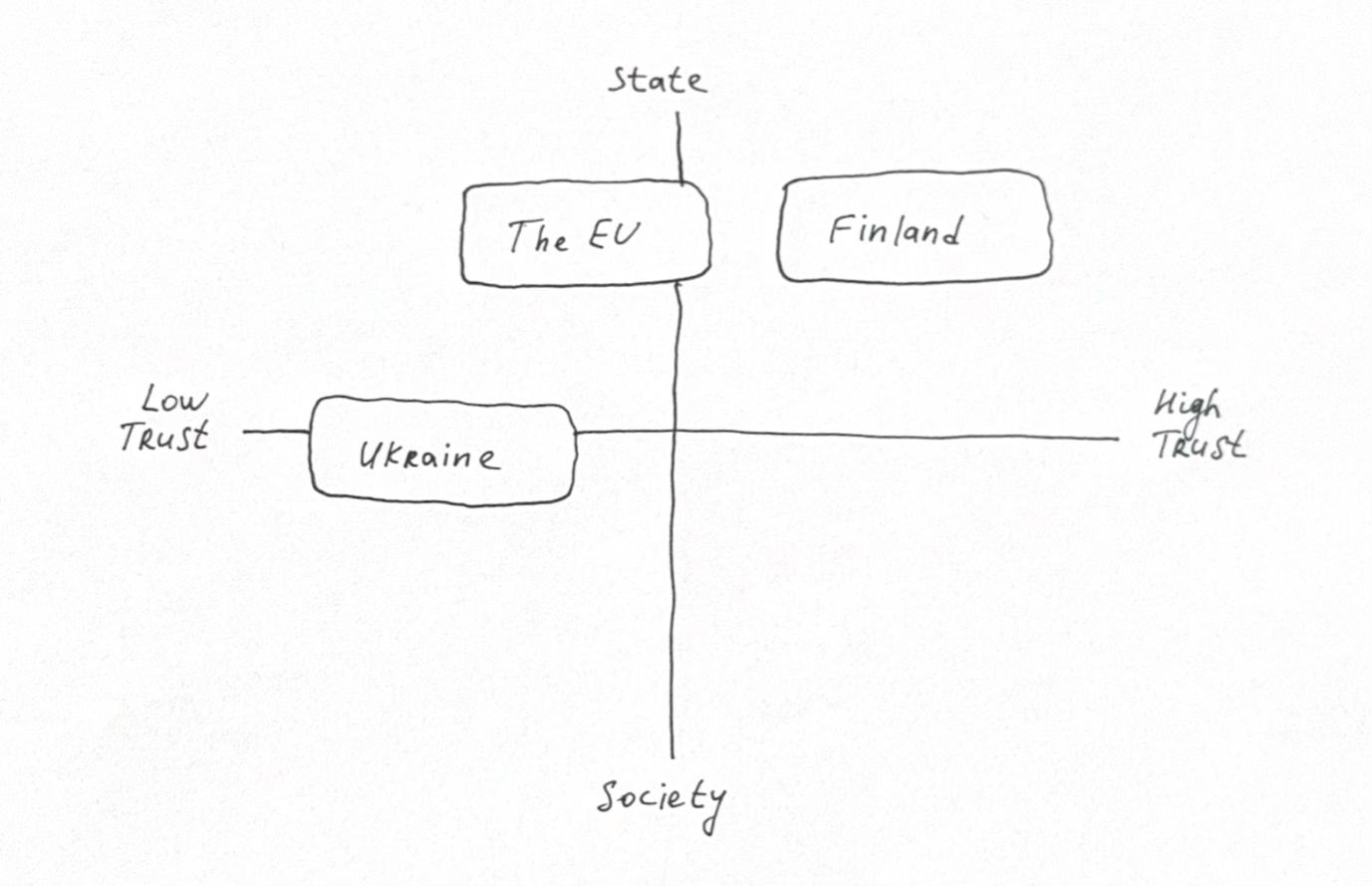
Three models of civic resilience: Ukraine, Finland, and the EU.
In Finland, the state builds the framework from the top, and people take part willingly because they trust it. 82% of Finns believe state institutions would be ready to protect their lives in a major emergency, against an OECD average of 53%. In Ukraine, the state builds that framework only partially. Society takes much of the state’s work because the state is weak and overstretched, and people’s active civic participation comes as a result of that weakness rather than from trust. The EU is in between. It has the institutions, the regulations, and the demand to increase people’s civic participation, but lacks a shared strategic culture, the trust to match, and the social fabric of its own.
Finnish resilience is preparedness by design, built by a strong state over decades and on trust. Ukrainian resilience emerged unorchestrated, out of weak institutions, and might be relevant today as a case to show what a society can do when the framework from above can’t keep up.
Where’s the opportunity for Ukraine and where is the weakness?
As the elements behind Ukraine’s civic resilience get identified, named, studied, and measured, there might be more interest in the Ukrainian experience, because Europe’s problem lies not in its regulations but in the fabric that produces resilience in the first place. Ukraine has it and keeps growing it, which might be an opportunity for mutually beneficial partnerships.
However, the Ukrainian experience isn’t a finished model you can pick up and put into practice, as there’s no curriculum, no performance indicators, no procedure for transferring it yet.
And Europeans might also have another reason to hesitate before trying to borrow practices from the Ukrainian case. This resilience was forged in a catastrophe no one would ever choose to engineer. The case is very valuable because it cost so much. But resilience born of catastrophe is exactly the kind that doesn’t transfer. You can’t stage or manufacture a catastrophe, because the moment you plan for it, you lose the emergency as the catalyst. That’s the weak spot for transferability and applicability of the case.
So developing, scaling, and exporting Ukraine’s social innovations isn’t a ready-made solution. It’s a possibility, which is workable, but hard. The Ukrainian case is too valuable to ignore and too singular to copy. The way forward isn’t to replicate it, but to name it, study it, and build partnerships around what it teaches.
What’s already there to build on?
At the OSCE forum in October 2025, the United Kingdom said openly that it takes inspiration both from the Finnish model and from “Ukraine’s extraordinary resilience, its ability to sustain the functions of society under extreme pressure”.
Finland itself updated its Security Strategy for Society on 16 January 2025, folding in the lessons of Russia’s war against Ukraine.
The London School of Economics has launched a three-year program, “Democratic Resilience in a New Age of War”, with Ukraine as a key partner and a live case study in how democracies govern under sustained pressure.
In the military sphere, equal partnership is already happening. In February 2025, NATO and Ukraine opened JATEC, a joint center that embeds Ukrainian personnel directly within the Alliance’s structure.
Why does any of this matter to Ukrainians?
First, this knowledge is a form of standing. It’s Ukraine’s own hard-won experience of a proactive civil society, of resilience and social innovation that others may want to learn from.
Second, it converts into money, partnerships, and influence. Once Ukrainian social innovations have a name and academic recognition behind them, it becomes possible to raise funding, build partnerships, and turn them into projects.
Third, it’s worth naming and preserving in its own right. This capacity of civil society to resist came at a terrible price, and it would be a loss to let it fade or be forgotten once peace comes.
In my previous column, I wrote about social innovations in Ukraine. Those innovations are part of civic resilience and the democratization of security, which Europe is paying close attention to right now. The EU is trying to work out how to spread responsibility for its own security across society as a whole, rather than leaving it to institutions alone. It is looking for concrete ways to bring ordinary people into the work of defense and resistance.
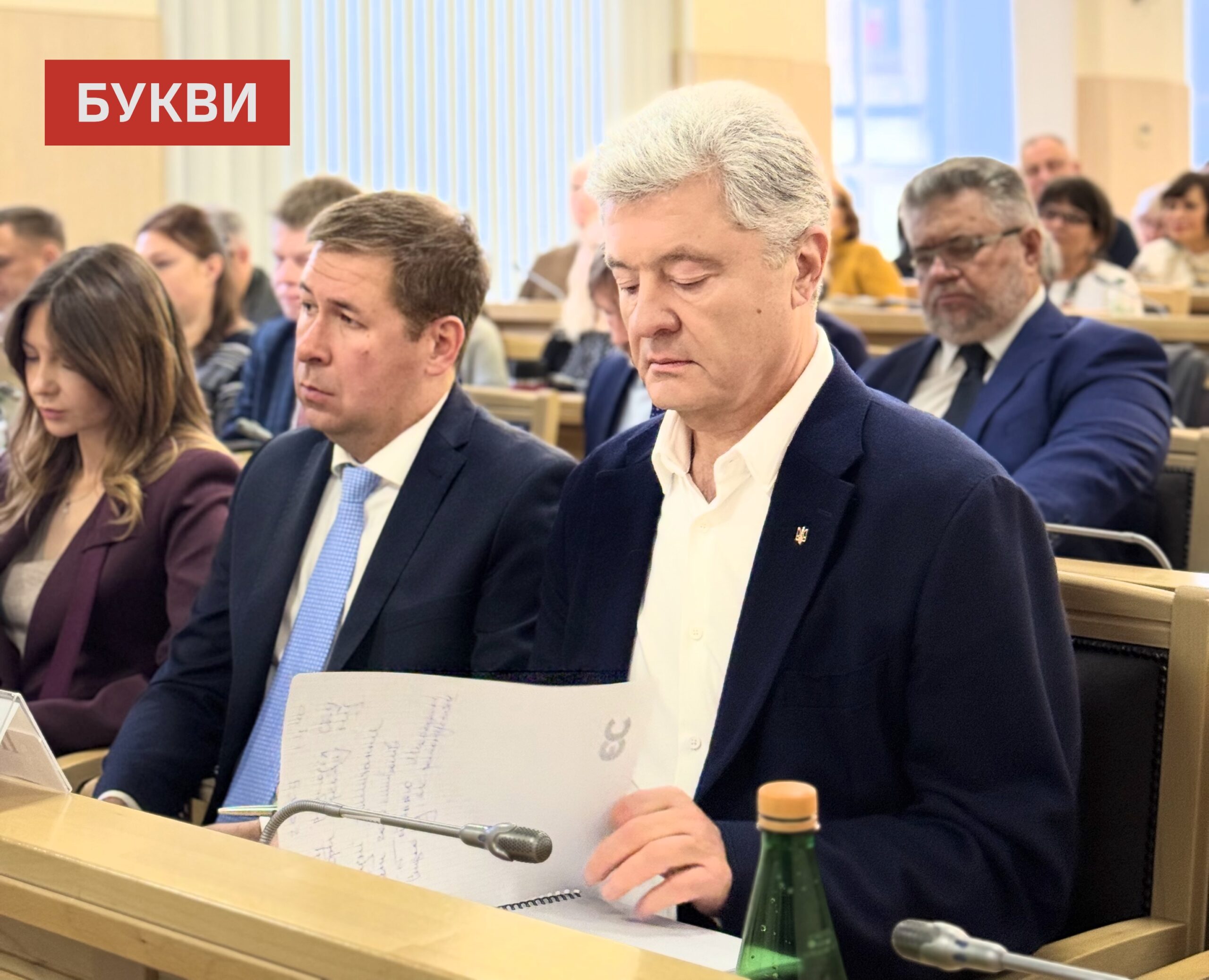
Petro Poroshenko’s lawyers have appealed to the High Anti-Corruption Court demanding that NABU be obligated to register proceedings regarding the fact of exerting influence on the court and to recognize Petro Poroshenko as a victim in the case of the Deputy Head of the Office of the President, Iryna Mudra, due to her pressure on Supreme Court judges who were considering a lawsuit to overturn sanctions.
In recent days, Moscow’s official rhetoric has been dominated by hysteria over the decision of…
In 2025, the deadliest year yet for civilians, Ukraine’s three largest charitable foundations raised a record 105.9 billion hryvnias. It is more than the years 2022–2024 combined. According to the UN, humanitarian aid in Ukraine was delivered by more than 450 organisations, reaching five million people over the course of the year. Civic foundations hold licences to purchase lethal weapons, which is a function states have monopolised for centuries. These record sums were underwritten by international government grants, which means foreign states now channel billions directly through Ukrainian civic funds, bypassing inter-state channels. It is hard to imagine a stronger institutional trust in civil society.
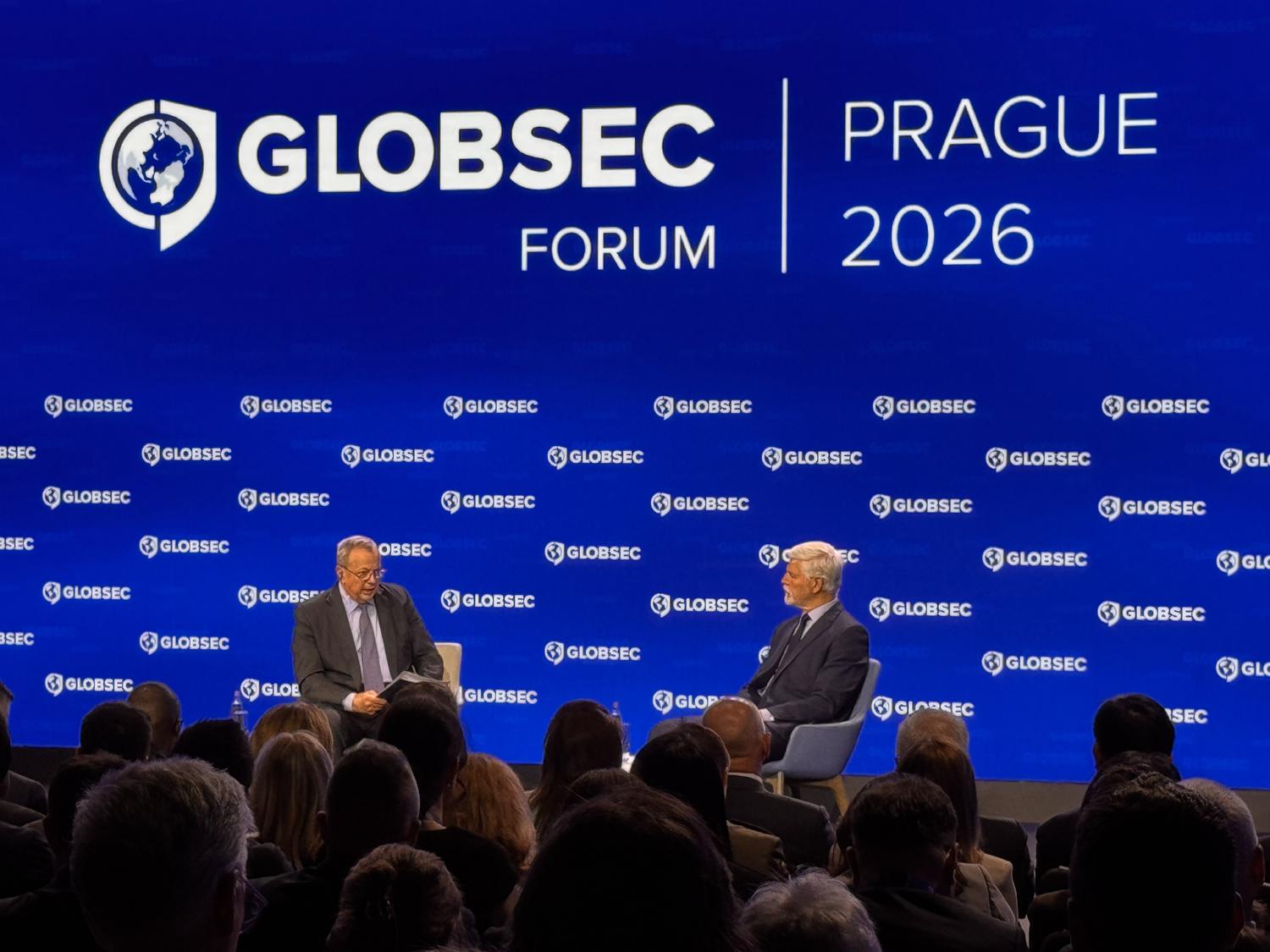
During the GLOBSEC Defence Forum 2026 in Prague, representatives of “Steel Front”, an initiative by Rinat Akhmetov, discussed with NATO delegations, military officials, and representatives of the European defense industry the lessons learned from Russia’s full-scale war against Ukraine.