


HACC must recognize Poroshenko as a victim in the case of Mudra, who pressured courts on sanctions – lawyers
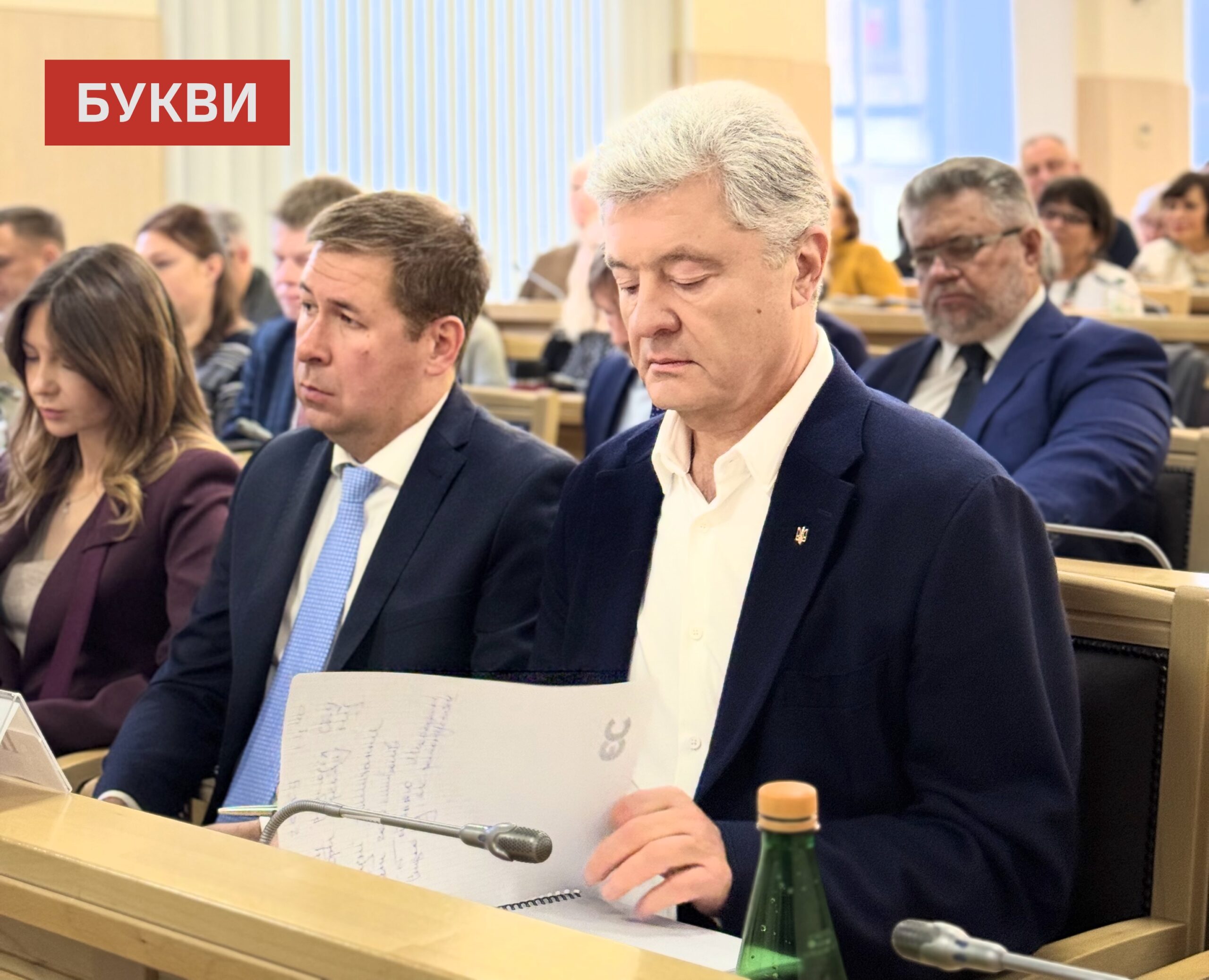
Petro Poroshenko’s lawyers have appealed to the High Anti-Corruption Court demanding that NABU be obligated to register proceedings regarding the fact of exerting influence on the court and to recognize Petro Poroshenko as a victim in the case of the Deputy Head of the Office of the President, Iryna Mudra, due to her pressure on Supreme Court judges who were considering a lawsuit to overturn sanctions. Source: Bukvy.
From the materials of the criminal proceedings regarding operation “Themis,” which are circulating in the media and social networks, it became known that Iryna Mudra followed instructions “from above” and, through the head of the Cassation Administrative Court within the Supreme Court, Ihor Dashutin, secured the desired verdict in favor of Zelenskyy.
The corresponding conversation between Iryna Mudra and her accomplice Mykytas, recorded during the course of covert investigative (search) actions (NSIS/NSRD), is contained on pages 78–79 of the first volume of NABU materials accompanying the motion for the choice of a preventive measure. This is one of the NSIS protocols where Mudra discusses this case and names the head of the Cassation Administrative Court within the Supreme Court, Dashutin. As is known, Poroshenko’s lawsuit against Zelenskyy regarding the cancellation of the Decree on sanctions was considered in this court. Representatives of the authorities turned a year and a half of the judicial process into a farce, and then, under pressure from Zelenskyy’s Office, three of the five judges signed off on the decision required by the authorities, notes lawyer Ihor Holovan.
The protocol is titled: “Conversation between Mykytas M.V. and Mudra I.R. dated April 11, 2026, regarding influence on the consideration of cases concerning sanctions and fulfillment of tasks assigned to her in exchange for protection from prosecution by law enforcement agencies (p. 207 of NSIS protocol No. 19/8478 dated July 15, 2026).”
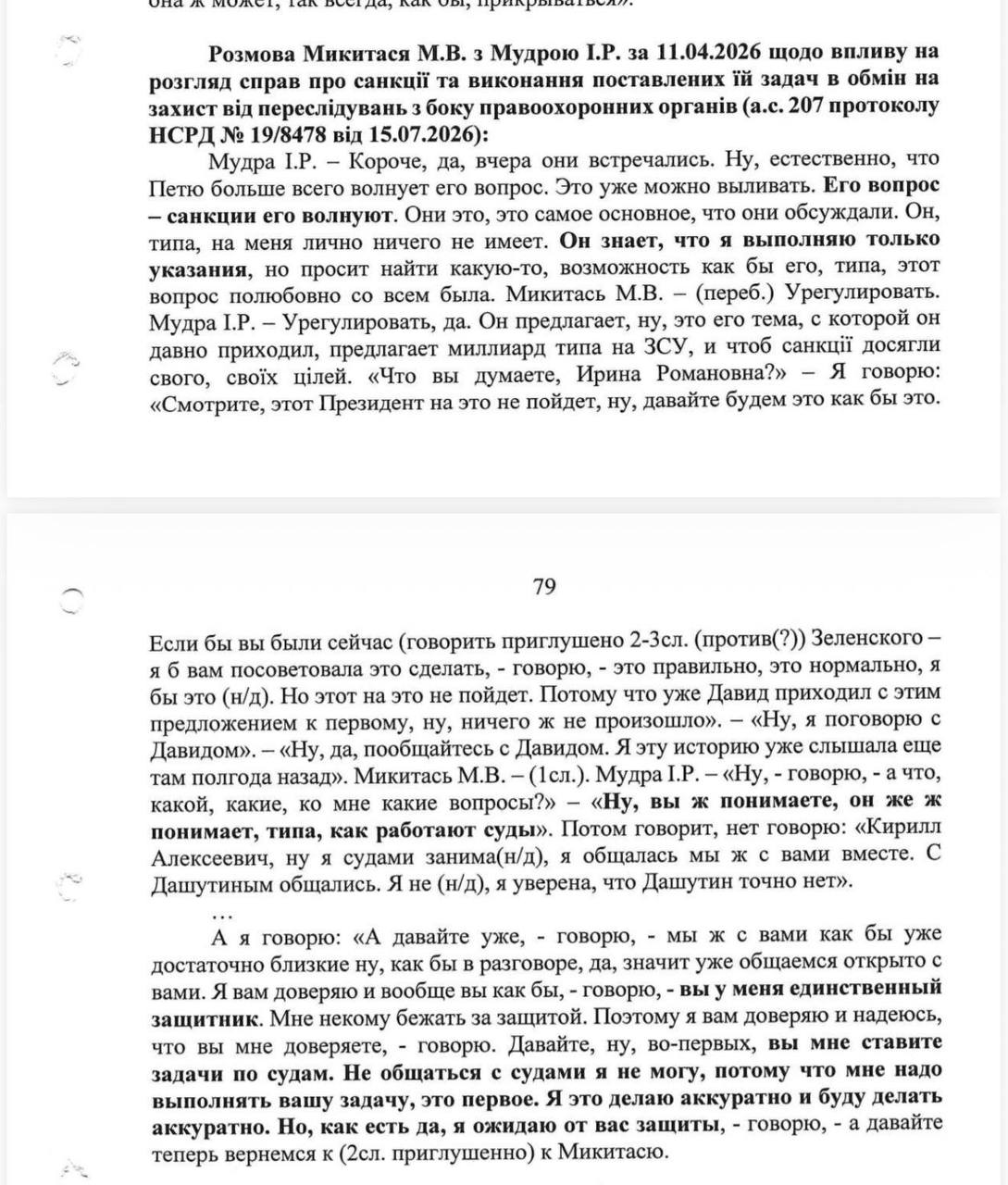
Thus, lawyers believe that NABU and SAP qualify Mudra’s actions as influencing the consideration of cases concerning sanctions in the Supreme Court. Moreover, it specifically concerns Poroshenko, whom Mudra, following her boss’s example, disparagingly calls “Petya”.
An excerpt from the case materials that was circulated online:
“That is, Mudra confirmed that she is ‘following instructions’ regarding sanctions, that she handled this matter in the courts and communicated with Dashutin to prevent a ruling in favor of Poroshenko,” the lawyer notes.
“Well, I dealt with the courts (inaudible), I talked—we were together, after all. Talked with Dashutin. I am not (inaudible), I am sure that Dashutin definitely not… Let’s, well, first of all, you set tasks for me regarding the courts. I cannot avoid communicating with the courts because I need to carry out your task first. I do this carefully and I will do it carefully,” Mudra says.
“Since Mudra’s actions to influence the Supreme Court are directed against Petro Poroshenko, accordingly, Poroshenko, as the leader of the opposition, must be recognized as a victim in these criminal proceedings,” lawyer Holovan believes.
“We believe that additional elements of crimes must be registered. We have addressed both NABU and the Prosecutor General’s Office with a report of a criminal offense and request the additional registration under Article 364 of the Criminal Code—abuse of authority or official position. And also under Article 376, which concerns interference with the activities of judicial bodies to obtain an unjust decision. We believe it is precisely these articles that characterize the activities of individuals who are currently suspects in NABU’s criminal proceedings. We hope that these legitimate demands of ours will be fulfilled,” Holovan said.
Lawyer Ilya Novikov adds: This is not about Poroshenko, but about protecting the entire Supreme Court, which is the last stronghold where a person can defend their rights.
Break the Supreme Court—and you break the state, Novikov believes.
“We have approached the High Council of Justice regarding this. This is the only body authorized to evaluate judges’ activities and to ask them specific questions. We ask that they question Mr. Ihor Dashutin on whether he really made such a strange decision after a conversation with the representative of the President’s Office, because usually these decisions regarding judges’ leaves are not made in this manner,” Novikov noted.
“The sanctions case is currently under consideration by the Grand Chamber of the Supreme Court. We hope that this situation was uncovered in time and that it will help us protect the judges of the Grand Chamber from further interference because the conditions and circumstances that caused such interference have not gone away.
The editorial team verified these statements and received confirmation that the materials from the NABU proceedings indeed contain a fragment of the conversation between the aforementioned individuals regarding influence on the judges to obtain a decision favorable to the defendant (the President of Ukraine).
In my previous column, I wrote about social innovations in Ukraine. Those innovations are part of civic resilience and the democratization of security, which Europe is paying close attention to right now. The EU is trying to work out how to spread responsibility for its own security across society as a whole, rather than leaving it to institutions alone. It is looking for concrete ways to bring ordinary people into the work of defense and resistance.
Petro Poroshenko’s lawyers have appealed to the High Anti-Corruption Court demanding that NABU be obligated to register proceedings regarding the fact of exerting influence on the court and to recognize Petro Poroshenko as a victim in the case of the Deputy Head of the Office of the President, Iryna Mudra, due to her pressure on Supreme Court judges who were considering a lawsuit to overturn sanctions.
Internationally recognized brands and financial institutions should direct capital to Ukraine now, not waiting for the hostilities to end. This was emphasized by Rinat Akhmetov, president of FC Shakhtar, during a working visit to UEFA headquarters in Nyon, Switzerland, where he met with UEFA President Aleksander Čeferin.
In recent days, Moscow’s official rhetoric has been dominated by hysteria over the decision of…
In 2025, the deadliest year yet for civilians, Ukraine’s three largest charitable foundations raised a record 105.9 billion hryvnias. It is more than the years 2022–2024 combined. According to the UN, humanitarian aid in Ukraine was delivered by more than 450 organisations, reaching five million people over the course of the year. Civic foundations hold licences to purchase lethal weapons, which is a function states have monopolised for centuries. These record sums were underwritten by international government grants, which means foreign states now channel billions directly through Ukrainian civic funds, bypassing inter-state channels. It is hard to imagine a stronger institutional trust in civil society.