Your Website May Soon Become Invisible: How AI Is Changing the Rules of the Game for Business
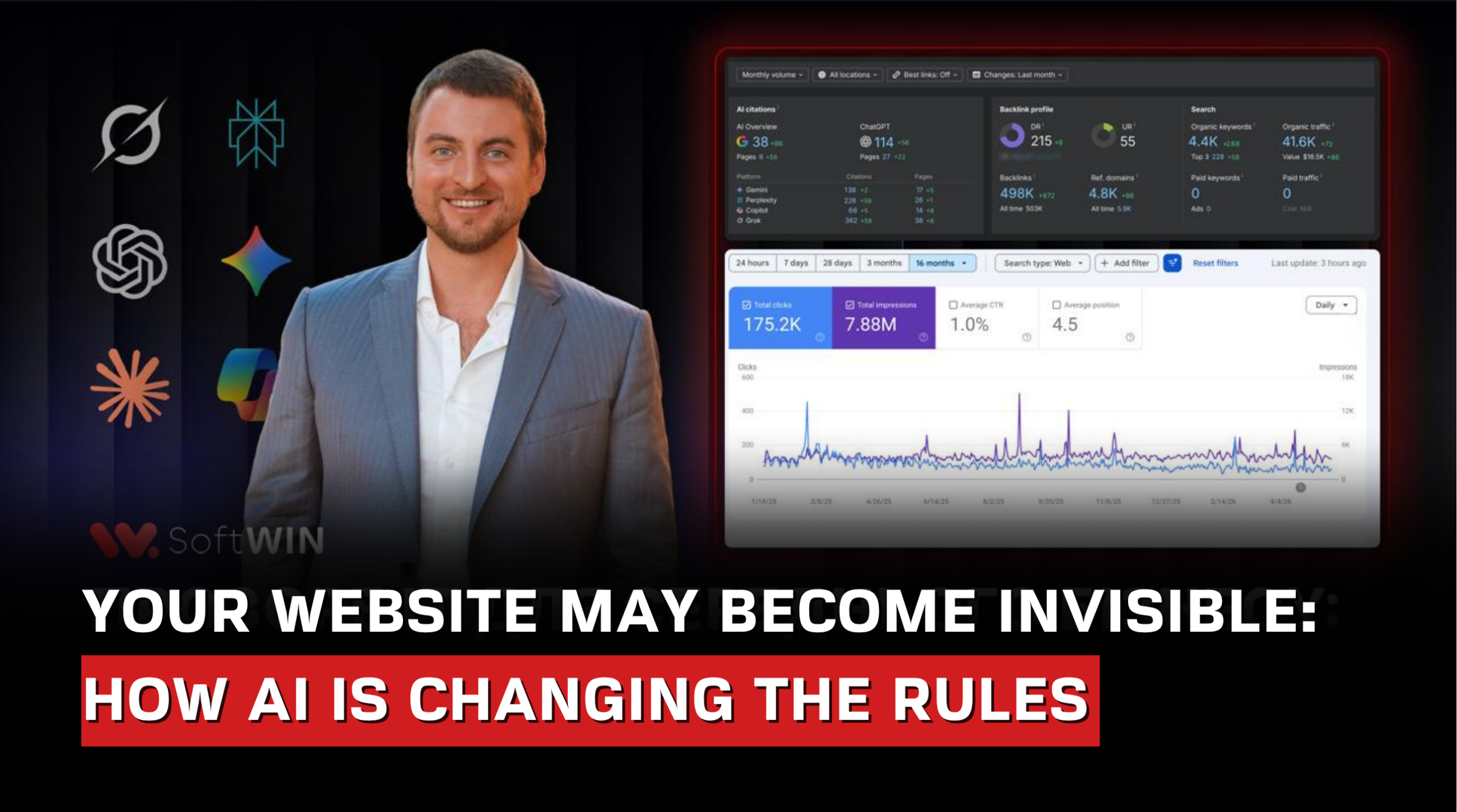
If you run an online store, restaurant, hotel, law firm, service business, or corporate website, this conversation is about how to stay visible to customers at a time when people are increasingly looking for answers not on Google, but through ChatGPT, Gemini, and other AI services.
Since 2022, the world has entered a period of profound transformation, with geopolitical challenges converging with a technological revolution. The widespread adoption of LLMs – from ChatGPT and Gemini to Perplexity and Claude – has fundamentally changed the way people consume information: traditional Google search is giving way to AI-generated answers, threatening the survival of conventional e-commerce and marketing models. At the same time, the war in Ukraine has accelerated another revolution – in defense – where computer vision, autonomous systems, and algorithmic warfare have become key factors.
Today, Ukraine’s technology sector is at the forefront of both shifts, moving from a strategy of “survival” toward global expansion and the development of a strong engineering backbone. Valerii Petrianyk, co-founder of SoftWin and MilitaryWin, works precisely at this intersection of IT expertise, visual effects, and defense innovation. With more than a decade of experience and an established team that has evolved from advertising production to developing AI- and computer vision-based systems, Valerii helps businesses and MilTech startups adapt to the new digital reality.
In an interview with Valerii, “Bukvy” discussed why traditional SEO is losing ground, how to “package” complex defense technologies for international markets, and why now is the time for Ukrainian businesses to embrace engineering transparency.
– Tell us about your professional journey and the foundation your companies are built on.
– I graduated from the Kharkiv State Academy of Design and Arts with a degree in Industrial Design. It is a rigorous engineering and manufacturing discipline at the intersection of aesthetics and technical design. Any industrial product or system (from an aircraft component to sophisticated machinery) requires precise drawings, CAD modeling, and an understanding of manufacturing technology.
Back in 2016, my graduation project focused on a drone for border protection. Even then, I saw the potential of such solutions, although the market was not yet ready for them at scale. That is why, in 2016, my partner and I founded Based.ua. We started with animation, VFX, and commercial advertising for agricultural holdings, banks, and product manufacturers. That was our “root”: we learned how to visualize complex ideas and work with polygonal and CAD modeling. This experience formed the backbone of our work for eight years and evolved into the expertise we have today.
– How did you navigate the transformation from 2022 to 2026, and why did it become a “turning point”?
– The period from 2022 to 2026 marked a systemic shift for both business and the way people consume information.
First, we saw the decline of the traditional SEO model. Users are moving from searching for links to querying LLMs (ChatGPT, Gemini, Perplexity, Claude). This is a fundamental crisis: the content companies invested in for years has been “absorbed” by these models. Businesses are no longer “googled”; they are “asked about.”
Second, the military paradigm has changed. Traditional air defense systems have proven ineffective against low-cost drones. This has created a cost asymmetry: million-dollar missiles versus thousand-dollar drones. That, in turn, has created demand for autonomous systems, computer vision, and distributed robotics.
– Let’s move on to the SoftWin brand. What is the company’s mission, and what is the main client problem you solve?
– We eliminate “technology blindness” among mid-sized businesses. Today, our clients are not limited to e-commerce. We work across a broad range of segments, from restaurants, hotels, and corporate websites to service platforms. For example, we successfully adapt even the websites of private attorneys and lawyers for AI-driven distribution, as searches for professional services are now becoming a key traffic driver. It is important to us that every business owner understands how their technology tools work, regardless of the niche.
Our mission is to make digital technology transparent and understandable. We do not try to convince clients to abandon large-scale solutions if they have the budget for them; we help them understand the logic behind those investments. We develop the product, set up all the processes, and take full responsibility for technical support, ensuring the system operates reliably. We do not interfere with the client’s internal business processes or train their staff, focusing exclusively on what we do best: technical excellence, monetization, and product development.
– We started by talking about the crisis in traditional marketing. How exactly is SoftWin changing its approach to business “visibility” now that SEO as we knew it is losing its relevance?
– The e-commerce world has fallen into the trap of the “old playbook.” Companies are still investing their budgets in SEO strategies built around link building, but Google AI Overviews and LLMs have fundamentally changed the landscape. Users no longer visit a website to get information – they want an answer from AI here and now.
Our experience with the hilfe-ua.de project became a foundation for SoftWin. It was a partner initiative that we joined during the 2022 recession. We created a large information hub for Ukrainians in Germany, taking responsibility for its architecture and technical implementation. The project reached millions of impressions, clearly demonstrating that algorithms favor structure and precise alignment with user intent.
That is why today we have moved away from “pure SEO” in favor of AI distribution:
- LLM optimization: We structure data so that language models “see” the product as an expert answer. What matters is becoming a “recommendation” in AI-generated results.
- Integration into AI ecosystems: We help businesses establish a presence where decisions are made – in chats, recommendation systems, and AI assistants.
- Value of the answer: We do not optimize for clicks. We focus on enabling a business to provide a clear, structured answer that the algorithm will prioritize.
– How do your two core businesses, SoftWin and MilitaryWin, operate today?
– Today, we occupy a niche where engineering, AI, and effective communication come together.
SoftWin is not simply about building websites. We help businesses survive in the age of AI search. We integrate companies into LLM ecosystems so they can become “recommendations” in AI-generated answers. We make digital technology transparent. Our goal is to turn technology into a tool for growth rather than a “black box”.
MilitaryWin is our answer to a problem faced by MilTech startups. They have strong engineering capabilities, but often lack the ability to “sell” them. We turn complex technical concepts into professional presentations, 3D demos, animation, and VFX. We have gone from developing concepts to gaining public recognition, as was the case with the “Katran” drone project, which received support at the ministerial level. We help companies navigate the entire go-to-market journey: from technical drawings to international trade shows.
– Speaking of MilitaryWin, why is there a need right now for a company focused specifically on “packaging” defense technologies, and what niche do you occupy in this market?
– Ukraine’s MilTech market is developing at a unique pace: startups are created, tested, and within weeks are already being tested in real combat conditions. However, we have encountered a systemic problem: a “gap” between strong engineering and the ability to present it effectively.
Many engineering teams have brilliant products – drones, electronic warfare systems, or robotic platforms – but they cannot effectively “sell” them to investors, foreign delegations, or the government. Their presentations look like “raw” code or incomprehensible technical drawings that fail to convey the product’s true capabilities.
We bridge this gap through a full cycle of go-to-market communication. We do not simply produce videos; we draw on our engineering background. We turn complex technical drawings into models the market can understand and explain in “business language” why a particular computer vision algorithm or drone design is needed on the battlefield. Finally, we create professional visuals – renders, animation, and VFX – that allow investors to see the product “in action” before it even enters mass production.
Our approach is about moving from “we are just engineers” to “we are building a product the global market can understand.” When a project, such as our “Katran” drone, receives support at the ministerial level and from international media, it proves that professional communication of engineering solutions is just as important to success as the development itself. We give startups the tools they need to be seen and heard amid global competition.
– What level of competition do you face in the segment where the company operates?
– If 20 years ago almost any product could “enter” the market relatively easily because competition was low, conditions today are much tougher.
We operate in the IT sector at a turning point between technological eras. The era of traditional “organic” traffic, as we have known it, is coming to an end.
What I am most proud of is the real-world results. We found our niche at the intersection of engineering and modern promotion methods at the right time. We do not simply follow trends; we understand how technical solutions affect business visibility in the age of AI search, and we turn that understanding into effective tools. My greatest source of pride is our team, which can transform complex ideas into clear, understandable, and functional digital assets, whether it is a business service or a defense solution.
– Why do you consider your approach a winning one?
– Because we solve real business problems.
SoftWin’s problem: traffic is declining and websites are no longer being seen (they are becoming less visible). The solution: we build a comprehensive presence so that businesses remain visible within the new AI distribution system.
MilitaryWin’s problem: engineers cannot communicate the value of their product to investors or the government. The solution: we package their engineering into a visually polished and easy-to-understand product.
We have around 25 specialists at SoftWin working across AI, Python, and e-commerce, and more than 20 design engineers and designers at MilitaryWin. We do not inflate our headcount; we rely on senior experts who have worked together for years.
– Developers often make clients dependent on their services, creating systems where it is impossible to make even the slightest change without the original developer. Where is the line between your “personalized approach” and simply creating a client’s technical dependency on SoftWin?
– In fact, our goal is exactly the opposite: to give the client full control. We do not keep the keys to the system hidden under our pillow. A “personalized approach” is not about “manually controlling” every click a client makes; it is about tailoring the architecture to their individual needs. We make businesses independent so they can continue developing on their own, while we remain a reliable technical backbone and provide professional support where it is genuinely needed.
– Does the client receive support after the project is launched?
– We ensure the stable operation of the client’s infrastructure. We have a regular support system that includes monitoring system stability, overseeing hosting and domains, and providing technical reports. The client has the confidence that the technical side of the business is running smoothly and can focus on growing the business.
Let me explain using MilitaryWin as an example. We focus on engineering and communications support for defense startups. We do not develop software or train AI algorithms. We provide the technical packaging of a product based on the client’s idea: we create CAD models, produce engineering drawings and technical calculations, and provide visualization, animation, VFX, and promotional materials that allow startups to present their solutions effectively to investors and at international trade shows.
– What are your plans for the company’s development over the next few years?
– My goal is to make technological development an accessible tool base. I want Ukrainian military technologies to become a global standard. When the country where you were born deploys solutions that save lives and change the rules of warfare, that is what real success means. We do not simply create code or visuals; we help shape a vision that enables our partners to scale and win.
In my previous column, I wrote about social innovations in Ukraine. Those innovations are part of civic resilience and the democratization of security, which Europe is paying close attention to right now. The EU is trying to work out how to spread responsibility for its own security across society as a whole, rather than leaving it to institutions alone. It is looking for concrete ways to bring ordinary people into the work of defense and resistance.
In recent days, Moscow’s official rhetoric has been dominated by hysteria over the decision of…
If you run an online store, restaurant, hotel, law firm, service business, or corporate website, this conversation is about how to stay visible to customers at a time when people are increasingly looking for answers not on Google, but through ChatGPT, Gemini, and other AI services.
In 2025, the deadliest year yet for civilians, Ukraine’s three largest charitable foundations raised a record 105.9 billion hryvnias. It is more than the years 2022–2024 combined. According to the UN, humanitarian aid in Ukraine was delivered by more than 450 organisations, reaching five million people over the course of the year. Civic foundations hold licences to purchase lethal weapons, which is a function states have monopolised for centuries. These record sums were underwritten by international government grants, which means foreign states now channel billions directly through Ukrainian civic funds, bypassing inter-state channels. It is hard to imagine a stronger institutional trust in civil society.
After the start of the full-scale invasion in February 2022, Ukraine witnessed an unprecedented wave of private support for the army. Citizens, big businesses, charitable foundations, and international philanthropists began financing the country’s defense alongside state assistance provided by international partners. Estimates of total private contributions range from tens to hundreds of billions of hryvnias. However, determining the exact amount remains difficult. In many cases, companies combine military aid, humanitarian programs, tax payments, social spending, and employee support in their reporting.