
Automatic Unfreezing of Bank Accounts Without Notices from Enforcement Authorities – Details of the Ministry of Justice Reform
Source: Bukvy
Amendments to Ukraine’s enforcement proceedings legislation, initiated by the Ministry of Justice of Ukraine, have entered into force. Among other measures, the reform provides for the automated lifting of attachments on bank accounts immediately after debts in enforcement proceedings have been fully settled. The main practical benefit for citizens is the complete elimination of the need to contact an enforcement officer in person and wait for paper decisions once the debt has been paid.
The first results are already visible: since 24 October (when the new system became operational), bank accounts have been automatically unfrozen in more than 2,000 enforcement proceedings, some of which were opened several years ago.
Previously, even after full repayment of a debt, citizens often had to contact a state enforcement officer in person, submit payment receipts, and wait for a decision lifting the account attachment to be issued. Given the workload of the State Enforcement Service offices, this wait could take a considerable amount of time.
Under the new rules, this process occurs automatically in a fully digital format:
- As soon as the full amount due is credited to the account of the State Enforcement Service (SES) body or a private enforcement officer, the Automated Enforcement Proceedings System (AEPS) generates a notification confirming debt clearance.
- The notification generated by the AEPS serves as a direct legal basis for automatically removing the individual’s records from the Unified Register of Debtors and lifting the attachment on their funds.
- The AEPS sends the debt clearance notification directly to banks and financial institutions on the day it is generated. Financial institutions are required to lift the attachment on the account no later than the day following receipt of this notification.
For the automated mechanism to trigger, the amount paid must cover all costs associated with the enforcement proceedings – including the enforcement fee (or the main remuneration of a private enforcement officer), enforcement expenses, and fines.
Andrii Haichenko, Deputy Minister of Justice of Ukraine for the State Enforcement Service, explained to Bukvy the practical nuances of how the new system operates, including cases involving multiple proceedings with different debt amounts, attachments under “old” proceedings, and interaction with banks:
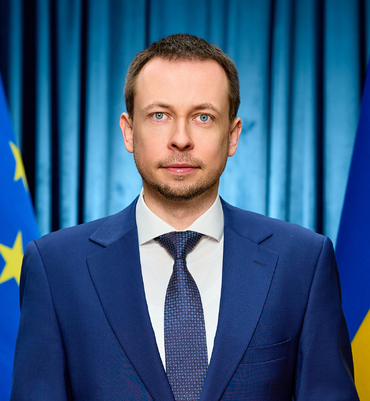
Andrii Haichenko, Deputy Minister of Justice of Ukraine for the State Enforcement Service
The automated account-unfreezing mechanism applies to enforcement proceedings in which the enforceable amount does not exceed 10 times the minimum monthly wage – which equals UAH 86,470 in 2026. As of October 2026, the vast majority of all open enforcement proceedings in Ukraine fall under this criterion (in particular, administrative fines and other minor monetary obligations).
This threshold applies to each proceeding separately: the UAH 86,470 limit is calculated per individual proceeding, not against the person’s total outstanding debts. For example, if three enforcement proceedings of UAH 80,000 each are opened against the same individual, account attachments can be automatically lifted for each proceeding after the debt is paid, despite the total debt exceeding the UAH 86,470 limit.
The simplified procedure applies to absolutely all enforcement proceedings, including those where accounts were attached prior to its introduction, as well as those handled by enforcement service departments that are temporarily non-operational, closed, or reorganized. This completely resolves the issue where a debtor could not contact an enforcement officer due to institutional changes or other reasons.
Banks do not have the authority to require additional confirmation from clients: “The bank unfreezes the account upon receiving a command from the payment system; that is precisely why the monetary cap was introduced – to strike a balance between convenience for citizens and risk management regarding potential abuses. The changes concerning electronic interaction between banks and the SES will apply to all proceedings, but automation covers the bulk of proceedings involving amounts up to 10 minimum wages,” Andrii Haichenko emphasized.
Other Key Changes Under Law No. 4833-IX
In addition to automating the lifting of account attachments, the entry into force of Law No. 4833-IX – which forms part of the implementation of Indicator 3.8, “Improving the Enforcement of Court Decisions”, under Ukraine’s Plan within the EU Ukraine Facility program – introduces a number of important social and procedural safeguards:
- Stronger protection of a debtor’s sole housing: the debt threshold below which enforcement cannot be levied against a debtor’s sole home and the land plot beneath it has been increased from 20 to 50 minimum monthly wages – up to UAH 432,350 in 2026.
- Safeguards for military personnel: during martial law and for one year after its termination or lifting, enforcement cannot be levied against the sole housing of military personnel regardless of the debt amount (with the exception of mortgages and compensation for harm caused by a criminal offense, bodily injury, or death).
- Protection for utility debtors: for the period of martial law, attachments on funds and property are lifted, and records of individuals are removed from the Unified Register of Debtors in proceedings concerning the recovery of debts for housing and utility services in areas of active hostilities and temporarily occupied territories.
- Digital certificates and resumption of cases: the system now enables the generation of electronic certificates from the Unified Register of Debtors featuring the Qualified Electronic Seal (QES) of SE “NAIS”, and regulates the procedure for resuming enforcement proceedings while retaining the original case number and materials without document duplication.
As a reminder, the Government previously introduced a model for young families under the eOselya program, allowing the interest rate to be reduced upon the birth of children.
Additionally, following Russian attacks on pharmaceutical warehouses, the Government decided to simplify control procedures and accelerate the delivery of imported medicines to pharmacies and hospitals.
Amendments to Ukraine’s enforcement proceedings legislation, initiated by the Ministry of Justice of Ukraine, have entered into force. Among other measures, the reform provides for the automated lifting of attachments on bank accounts immediately after debts in enforcement proceedings have been fully settled. The main practical benefit for citizens is the complete elimination of the need to contact an enforcement officer in person and wait for paper decisions once the debt has been paid.
In my previous column, I wrote about social innovations in Ukraine. Those innovations are part of civic resilience and the democratization of security, which Europe is paying close attention to right now. The EU is trying to work out how to spread responsibility for its own security across society as a whole, rather than leaving it to institutions alone. It is looking for concrete ways to bring ordinary people into the work of defense and resistance.
Petro Poroshenko’s lawyers have appealed to the High Anti-Corruption Court demanding that NABU be obligated to register proceedings regarding the fact of exerting influence on the court and to recognize Petro Poroshenko as a victim in the case of the Deputy Head of the Office of the President, Iryna Mudra, due to her pressure on Supreme Court judges who were considering a lawsuit to overturn sanctions.
Internationally recognized brands and financial institutions should direct capital to Ukraine now, not waiting for the hostilities to end. This was emphasized by Rinat Akhmetov, president of FC Shakhtar, during a working visit to UEFA headquarters in Nyon, Switzerland, where he met with UEFA President Aleksander Čeferin.
In recent days, Moscow’s official rhetoric has been dominated by hysteria over the decision of…