

Yana Barinova at Vienna Contemporary2024: Ukraine, art, and global energy transformation
At Viennacontemporary2024, a leading European contemporary art fair held annualy in Austria’s capital, Bukvy caught up with Yana Barinova who leads European policies and Ukraine relations at Erste Foundation
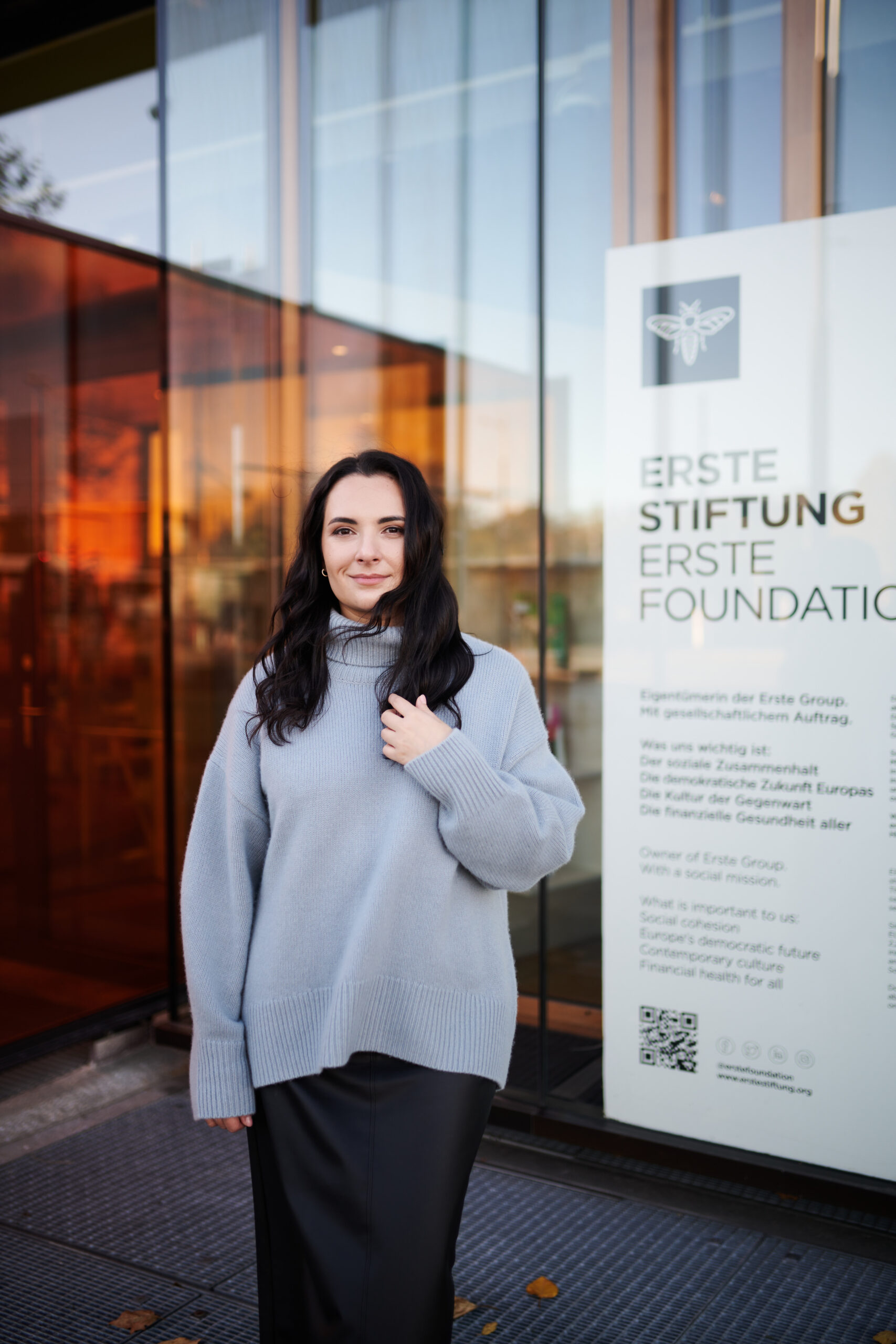
You’ve been working in Vienna with Erste Foundation for 2.5 years now, focusing on systemic support for Ukraine. What projects have you helped to realize and what’s coming next?
War is destructive in every way—it’s death and devastation. The only thing we can do is push for a just and quick end of it. That’s exactly what I’m doing at Erste Foundation, a powerful European institution that has been offering social, cultural, and humanitarian aid to Ukraine from day one of the invasion. Every project we’ve completed has benefited both Ukrainian artists, activists, and journalists, as well as the nation of Ukraine itself, which is fighting off barbarism and needs the support of the entire civilized world.
Over these 2.5 years, we’ve launched several initiatives to support civil society, the media, cultural projects, and think tanks. Moving forward, we plan to expand these programs and bring in more international partners.
Getting the world’s attention isn’t easy, and it requires ongoing, professional effort. It’s not just about aggressively pushing our agenda; you also need to integrate into existing events and institutions. For instance, my collaboration with the prestigious European Alpbach Forum started with a photo exhibition, Spalena, in 2022, featuring works by Mstyslav Chernov. By 2023, I was curating the entire art and cultural program.
Another project that is dear to me was Policy Labs, which is more of a leadership initiative, something I created based on my own understanding of the needs of Ukrainian cultural management. This will be the fifth time cultural managers from Ukraine and Europe get together in Vienna for an intensive workshop to develop a unified vision of the Euro-integration reforms necessary for Ukrainian culture.
You recently moderated a panel on Ukraine at viennacontemporary 2024. Can you share more about that the event?
This year’s theme was “Energy.” The future of sustainable development hinges on a “green” and fair transition. The decisions we make today don’t just impact the climate; they also influence geopolitical stability, economic security, and the well-being of our societies. Our future depends on the steps we take now to create a sustainable and resilient energy landscape.
This transformation is critical as Europe pushes to achieve climate neutrality by 2050. A coordinated effort between countries, communities, and the private sector is essential to effectively manage the complex processes of renewable energy production, distribution, and consumption.
But this energy transition is not just a technological shift—it’s a profound social transformation that requires inclusive collaboration. We discussed the role of both the EU and Ukraine in these global efforts.
How has the world’s perception of Ukraine changed since the war began?
Over the years of full-scale war, the world’s perception of Ukraine has shifted dramatically. Ukraine is no longer seen as a backwater country on the periphery of Europe. It has become a symbol of the fight for freedom and independence, as well as a source of cultural and artistic strength.
Ukrainian artists working under the dire conditions of war have captured global attention with their creativity. Ukraine is now viewed as an important cultural and geopolitical player.
In countries that stand by Ukraine, we are experiencing an expansion—we’re exporting much more of our cultural output than we are receiving. This is due in large part to the large number of Ukrainian refugees who, despite the tragedy, have created dozens, if not hundreds, of initiatives around the world that remind the civilized world of the ongoing aggression.
It’s vital that we don’t stop here. We must continue engaging with major Ukrainian and international institutions wherever possible.
Petro Poroshenko’s lawyers have appealed to the High Anti-Corruption Court demanding that NABU be obligated to register proceedings regarding the fact of exerting influence on the court and to recognize Petro Poroshenko as a victim in the case of the Deputy Head of the Office of the President, Iryna Mudra, due to her pressure on Supreme Court judges who were considering a lawsuit to overturn sanctions.
In recent days, Moscow’s official rhetoric has been dominated by hysteria over the decision of…
In 2025, the deadliest year yet for civilians, Ukraine’s three largest charitable foundations raised a record 105.9 billion hryvnias. It is more than the years 2022–2024 combined. According to the UN, humanitarian aid in Ukraine was delivered by more than 450 organisations, reaching five million people over the course of the year. Civic foundations hold licences to purchase lethal weapons, which is a function states have monopolised for centuries. These record sums were underwritten by international government grants, which means foreign states now channel billions directly through Ukrainian civic funds, bypassing inter-state channels. It is hard to imagine a stronger institutional trust in civil society.
During the GLOBSEC Defence Forum 2026 in Prague, representatives of “Steel Front”, an initiative by Rinat Akhmetov, discussed with NATO delegations, military officials, and representatives of the European defense industry the lessons learned from Russia’s full-scale war against Ukraine.
After the start of the full-scale invasion in February 2022, Ukraine witnessed an unprecedented wave of private support for the army. Citizens, big businesses, charitable foundations, and international philanthropists began financing the country’s defense alongside state assistance provided by international partners. Estimates of total private contributions range from tens to hundreds of billions of hryvnias. However, determining the exact amount remains difficult. In many cases, companies combine military aid, humanitarian programs, tax payments, social spending, and employee support in their reporting.